Materials
Thread count, explained by someone who buys the cloth
17 April 2026 · 6 min read
Above 400, the number stops meaning anything — and the reason is a counting trick that is entirely legal. Here is what to look at instead.
Thread count is the number of threads in a square inch of fabric, counted across and along. A 200 count has 100 threads one way and 100 the other. That is the whole idea, and up to a point it works: more threads in the same space means finer yarn, and finer yarn means a smoother, denser cloth.
The point where it stops working is around 400.
The counting trick
A physical limit exists. You can only fit so many threads into an inch before the cloth becomes stiff board. For most cotton that ceiling sits somewhere between 400 and 500.
Mills reach 800 and 1000 by using multi-ply yarn and counting each ply. Take two thin threads, twist them into one, weave it — and count it as two. A "1000 thread count" sheet is often a 250 count woven from four-ply yarn made of short, cheap fibres. It is legal, it is common, and it produces a heavier, hotter, less durable sheet than an honest 300.
The number tells you how the mill counts. The fibre tells you how the sheet will sleep.
What actually matters
Fibre length
Cotton is sold by staple length — how long each individual fibre is before it is spun. Long-staple cotton (Egyptian, Pima, Supima) spins into a smoother, stronger yarn with fewer ends poking out of the surface. Fewer ends means less pilling and a cloth that stays smooth after fifty washes rather than twenty.
Short-staple cotton at 1000 thread count will pill. Long-staple at 300 will not. This single factor outweighs the number on the packet.
The weave
Percale is a simple one-over-one weave. Matte, crisp, breathable, and it makes that faint dry rustle when you get into bed. Sateen floats several threads over one, which puts more fibre surface on top: smoother, slightly heavier, with a low sheen, and marginally warmer.
Neither is better. Percale suits people who sleep warm and like a hotel-bed crispness. Sateen suits people who want the cloth to feel soft against the skin immediately.
Finishing
Combing removes the shortest fibres before spinning. Mercerising treats the yarn so it takes dye better and holds strength. Neither appears on the front of the packet, both change how the sheet looks after a year.
What good numbers look like
- 200–300 percale — crisp, light, excellent for hot sleepers. Nothing wrong with 200 if the cotton is long-staple.
- 300–400 sateen — smooth and cool to the touch. This is the sweet spot for most people.
- 400–500 — genuinely dense, genuinely more expensive, slightly warmer. Worth it if you like weight.
- Above 600 — treat the number as marketing and go look at the fibre.
And linen ignores all of this
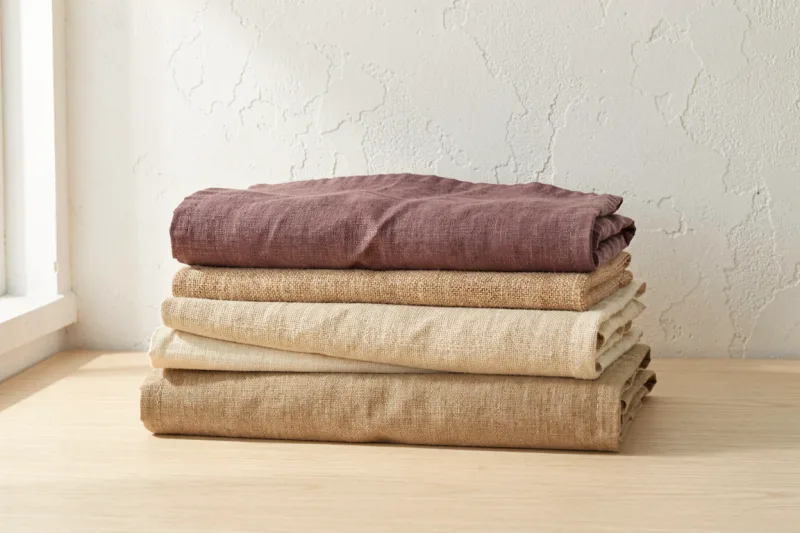
Linen is measured in GSM, grams per square metre, because flax fibre is thicker and the count would be meaningless. Bedding linen runs roughly 150–190 GSM. Below 140 it is thin enough to see through; above 200 it is heavy enough to feel like canvas until several washes in.
So: read the fibre, read the weave, and treat any number over 600 as a reason to look more carefully rather than less.